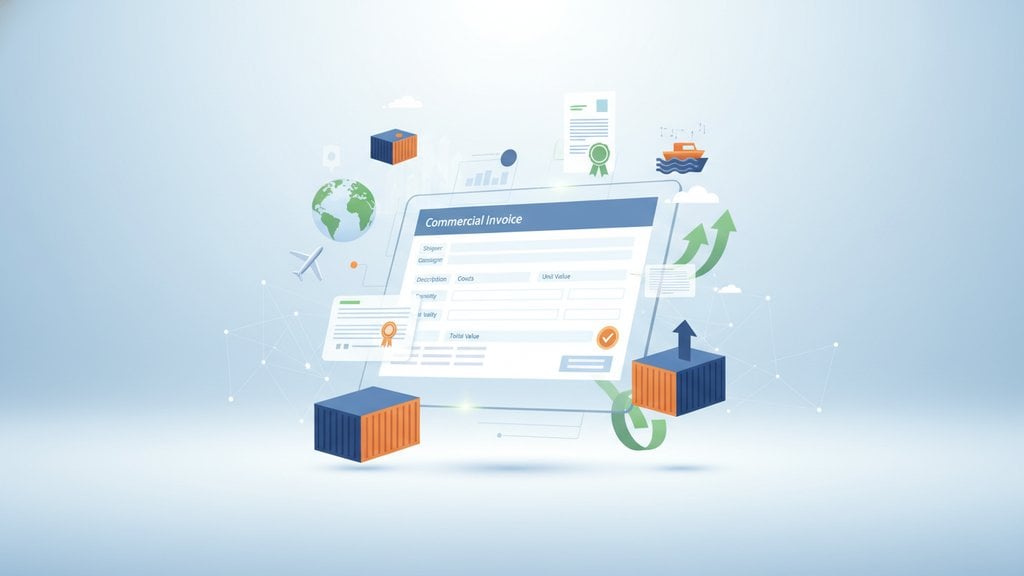
A commercial invoice for international shipping is the primary customs document that travels with your goods across borders. It tells customs officers exactly what you're shipping, what it's worth, and who's sending and receiving it. Get it wrong, and your shipment can be held, fined, or returned, so knowing every required field before you ship is non-negotiable.
Content Table
What a Commercial Invoice Actually Is
A commercial invoice is not the same as a proforma invoice or a packing list. It is the legally binding document that establishes the transaction between exporter and importer. Customs authorities in the destination country use it to assess duties and taxes, verify that the goods match what was declared, and confirm the shipment complies with import regulations.
Unlike a domestic invoice, a commercial invoice for international shipping must satisfy two sets of rules simultaneously: the export requirements of the origin country and the import requirements of the destination country. This is why cross-border invoicing can feel complicated, especially when you're selling to multiple markets.
Required Fields on Every Commercial Invoice
While specific rules vary by country, a solid set of core fields is expected on virtually every international commercial invoice. Missing even one can trigger a customs hold.
- Seller (exporter) details: Full legal name, address, and contact information of the business or individual shipping the goods.
- Buyer (importer) details: Full legal name and address of the recipient. This must match the import documentation exactly.
- Invoice number and date: A unique reference number and the date the invoice was issued. Customs uses this to cross-reference shipments.
- Description of goods: A clear, specific description of each item. Vague descriptions like "merchandise" or "parts" are a red flag for customs officers.
- HS code (Harmonized System code): The internationally standardized 6-digit tariff classification code for each product. Many countries require 8 or 10 digits.
- Quantity and unit of measure: Number of units, weight, or volume, depending on the product type.
- Unit price and total value: The price per item and the total transaction value, in a clearly stated currency.
- Currency: Explicitly state the currency (USD, EUR, GBP, etc.). Never leave this implied.
- Country of origin: Where the goods were manufactured or substantially transformed. This affects tariff rates and trade agreement eligibility.
- Incoterms: The agreed trade term (EXW, FOB, CIF, DAP, etc.) that defines who is responsible for shipping costs, insurance, and risk at each stage of the journey.
- Payment terms: Net 30, advance payment, letter of credit, etc.
- Shipping details: Port of loading, port of discharge, and the carrier or tracking reference where applicable.
Country-Specific Requirements You Need to Know
Beyond the universal fields above, individual countries layer on their own export invoice requirements. Here is a snapshot of how requirements differ across key markets.
| Country | Notable Extra Requirements | Tax/VAT ID Required? |
|---|---|---|
| United States | Ultimate consignee name, EIN or SSN for high-value imports, AES filing for exports over $2,500 | Importer of Record (IOR) number required |
| Germany / EU | VAT number (EORI number for customs), EU customs value per Union Customs Code | Yes, VAT and EORI numbers mandatory |
| United Kingdom | EORI number (UK-specific post-Brexit), commodity codes per UK Global Tariff | Yes, UK VAT number if registered |
| Canada | Business Number (BN), country of origin per CUSMA/USMCA for preferential rates | GST/HST number if applicable |
| Australia | ABN (Australian Business Number), import declaration for goods over AUD 1,000 | ABN recommended; GST registration if applicable |
EU countries (Germany, France, Spain, Netherlands, Austria, Italy, Ireland) share a common customs framework under the Union Customs Code, but each country also has its own domestic VAT invoicing rules on top of that. A commercial invoice that clears German customs may still need adjustments to satisfy French domestic tax law if the buyer is claiming a VAT deduction.
How the Invoice Connects to Your Customs Declaration
Your customs declaration is the formal document submitted to the customs authority (electronically in most countries today). The commercial invoice is the supporting evidence that backs it up. Customs officers compare the two documents to confirm the declared value, origin, and description match what is actually being shipped.
In the US, the CBP (Customs and Border Protection) requires the commercial invoice to be filed as part of the entry package. In the EU, it accompanies the SAD (Single Administrative Document) or its electronic equivalent. In the UK post-Brexit, it supports the customs import declaration submitted through CHIEF or CDS.
The value you declare on the customs form must match the commercial invoice exactly. Any discrepancy, even a rounding difference, can trigger a query or a physical inspection of the shipment.
Common Mistakes That Delay Shipments
These are the errors that freight forwarders and customs brokers see most often on international invoices.
- Vague product descriptions: Writing "electronic goods" instead of "lithium-ion battery chargers for mobile phones, model XYZ" gives customs nothing to work with.
- Wrong or missing HS code: Either omitted entirely or copied from a domestic price list that uses a different classification system.
- Currency not stated: An invoice showing "500" with no currency is technically incomplete and can cause valuation disputes.
- Undervaluing goods: Declaring a lower value to reduce duties is customs fraud. Penalties can include seizure of goods and fines up to several times the duty owed.
- Seller/buyer address mismatch: The addresses on the invoice must match the addresses on the bill of lading and the customs entry. Any mismatch raises flags.
- Missing country of origin: Especially important when trade agreements (USMCA, CETA, UK-EU TCA) could reduce or eliminate duties, but only if origin is properly documented.
- Wrong Incoterm: Using FOB when the actual agreement is CIF changes how customs calculates the dutiable value in many countries.
Practical Checklist Before You Ship
Run through this before finalizing any commercial invoice for an international shipment.
- Confirm the buyer's full legal name and address match their import documentation.
- Look up the correct HS code in the destination country's official tariff schedule, not just your origin country's version.
- State the currency explicitly on every line item.
- Include the country of origin and check whether a preferential trade agreement applies.
- Confirm the Incoterm matches the actual shipping contract and that the invoice value reflects it correctly.
- Add any country-specific fields (VAT number, EORI, ABN, BN) based on where you're shipping to.
- Keep a copy of the invoice on file for at least 5 years. Most countries require this for audit purposes.
Because requirements change and vary so much by destination, checking a country-specific guide before each new market you ship to is genuinely worth the few minutes it takes.

Check exact invoice requirements for your destination country
Our country-specific invoice requirements guide shows every mandatory field for a valid commercial invoice for international shipping, including common mistakes to avoid and links to official legal sources, for the US, UK, EU countries, Canada, Australia, and more.
Check Invoice Requirements →
They are closely related but not always identical. A commercial invoice documents the sale transaction between buyer and seller. Some countries (notably Canada) use a specific "customs invoice" form when the goods exceed a certain value threshold. In most cases, a properly completed commercial invoice serves as the customs invoice, but always check the destination country's import rules to be sure.
The standard practice is three copies: one for customs in the destination country, one for the carrier or freight forwarder, and one retained by the exporter. Some countries or carriers request additional copies. In practice, most customs submissions are now electronic, so the physical copy count matters less, but you should still keep a signed original on file for audit purposes.
Many countries require the commercial invoice to be signed by an authorized representative of the exporting company, sometimes with a company stamp. The US, for example, does not strictly require a signature on the invoice itself, but the customs entry package must be certified. EU countries generally require the exporter's signature or at least a named contact. Check the specific requirements for your destination before shipping.
English is widely accepted for international trade documents, and most customs authorities worldwide process English-language invoices without issue. However, some countries (notably certain Latin American and Middle Eastern markets) may require a translation or a bilingual invoice. For high-value or regulated goods, it is worth confirming with your customs broker or the destination country's customs authority whether a local-language version is needed.
A single base template can work for most shipments if it includes all the universal required fields. The issue is the country-specific extras: VAT or GST numbers, EORI numbers, specific tariff code formats, and locally required statements. The safest approach is to start with a comprehensive base template and add a country-specific layer for each destination market rather than maintaining entirely separate documents for each country.
You will need to issue a corrected invoice and, in most cases, notify your customs broker or freight forwarder immediately so they can file an amendment with the destination customs authority before the goods clear. If the error is discovered after clearance, you may need to file a post-entry amendment (called a post-entry correction or a duty drawback claim, depending on the situation). Delays and additional fees are common in these scenarios, which is why getting it right before shipping is worth the effort.